Animation
Debt, Divestment, and Déjà Vu
The Paramount-Warner Bros. merger threatens to drastically downsize the American animation industry by consolidating the number of major animation producers, cutting production slates, and drastically reducing job opportunities in an already depleted field. The deal unites two of Hollywood's animation powerhouses: Warner Bros., which includes Warner Bros. Animation, Cartoon Network, and Hanna-Barbera, and Paramount, which includes Nickelodeon Animation Studio, DC Studios, and a roster of classic IP.
American animation workers have already recently suffered successive rounds of layoffs due to a significant decline in the number of programs “greenlit.” The industry had contracted to offset significant debt in the wake of the pandemic and the corporate overexpansion of the streaming era. This latest proposed merger takes a significant buyer out of an already constricted marketplace. Recent history has demonstrated that these giant corporate mergers result in debt that motivates cost-cutting measures that not only eliminate numerous jobs but also limit consumer choices. Rather than participating in a competitive, productive industry, new productions are shelved and older titles are pulled from streaming services to achieve dubious tax write-offs and savings on residuals.
Furthermore, Animation is a particularly vulnerable sector of the American entertainment industry. Animation productions struggle to justify the expense of the medium when traditional success metrics like box office earnings fail to meet the audience, particularly children, where they interact with animation most: streaming services. Recent mergers suggest the $79 billion debt of a combined Paramount-Warner Bros. would result in further mass layoffs, particularly in animation, along with increased outsourcing, a loss of domestic creative workers, fewer original productions, and restricted programming choices on a more expensive, consolidated streaming service.
The Animation Holdings to be Consolidated Are Myriad
The Paramount-Warner Bros. merger threatens to drastically downsize the American animation industry by reducing the number of production studios and purchasing outlets, limiting job opportunities, and cutting production slates. The consolidation of massive IP empires sparks significant concerns over creative suppression, workforce reductions, and consumer options.
| Paramount Skydance | Warner Bros. Discovery |
| Production Studios or Units | |
| Nickelodeon Animation Studio | Warner Bros. Animation |
| Paramount Animation | Warner Bros. Feature Animation |
| Skydance Animation | Cartoon Network Studios |
| MTV Animation | Williams Street Productions |
| CBS Eye Animation Productions | DC Studios (live action & animation) |
| Miramax Animation | Hanna-Barbera Studios Europe |
| Networks & Brands | |
| Nickelodeon Television Network | Cartoon Network |
| MTV Television Network | Adult Swim/Toonami |
| Cartoonito | |
| Boomerang | |
| Key Franchises & IP | |
| SpongeBob SquarePants, Teenage Mutant Ninja Turtles, PAW Patrol, Dora the Explorer, Avatar: The Last Airbender, South Park, Sonic the Hedgehog, Fleischer Animation Library, Terrytoons Library | Looney Tunes, Scooby-Doo, the DC Universe (e.g., Batman: The Animated Series, Teen Titans Go!), Tom and Jerry, The Powerpuff Girls, Adventure Time, Rick and Morty, Hanna-Barbera Library |
In Animation, Consolidation Consistently Brings Layoffs
Over the past five to six years, California has been steadily losing animation jobs (nearly 5% between 2019 and 2024). While The Animation Guild has fought to curtail “runaway production,” and the state has recently enacted tax incentives for animated productions, they do little to offset jobs already lost due to corporate mergers of years past:
| 2021 | After purchasing 20th Century-Fox, Disney shut down Fox's highly successful Blue Sky Studios. Andrea Miloro, Co-President of Fox Animation, resigned. |
| 2022 | As a result of the Warner Bros.-Discovery merger, Warner Bros. Television Group laid off 26% of its workforce and announced plans to consolidate Cartoon Network Studios and Warner Bros. Animation. |
| 2024 | Disney cost-cutting continued, with 14% of Pixar's workforce laid off. |
| 2024 | The Animation Guild estimated one third of their animation workforce had experienced layoffs related to post-merger restructuring. |
| 2025 | Warner Bros. Discovery deprioritized Cartoon Network in a move to prioritize adult and family programming over children’s programming, particularly for its streaming platform, Max. |
| 2025 | In the wake of the Paramount-Skydance merger, the new company laid off more than 2,000 workers, including Paramount Animation president Ramsey Naito, despite a highly successful eight year run. Later, Nickelodeon Studio Animation was “folded” into CBS Studios. |
The extensive animation holdings of a proposed Paramount-Warner Bros. merger would give the company control of a significant number of IP, distribution channels, and production studios. These entities would be weighed against their abilities to offset incredible corporate debt, and recent history has shown that the most common strategy is layoffs on an unprecedented scale. History shows that further corporate consolidation would significantly contribute to an already shrinking job market.
Fewer Greenlights for Animated Projects & Less Negotiation Power
Though Paramount Skydance’s Chief Legal Officer Makan Delrahim insists the proposed merger would lead to “increased content production”, recent history has shown quite a different trend for the animation industry. Despite a global animation market valued at over $460 billion in 2025 (up from $392.54 billion in 2022), the number of greenlit animated projects has declined steadily since 2021.
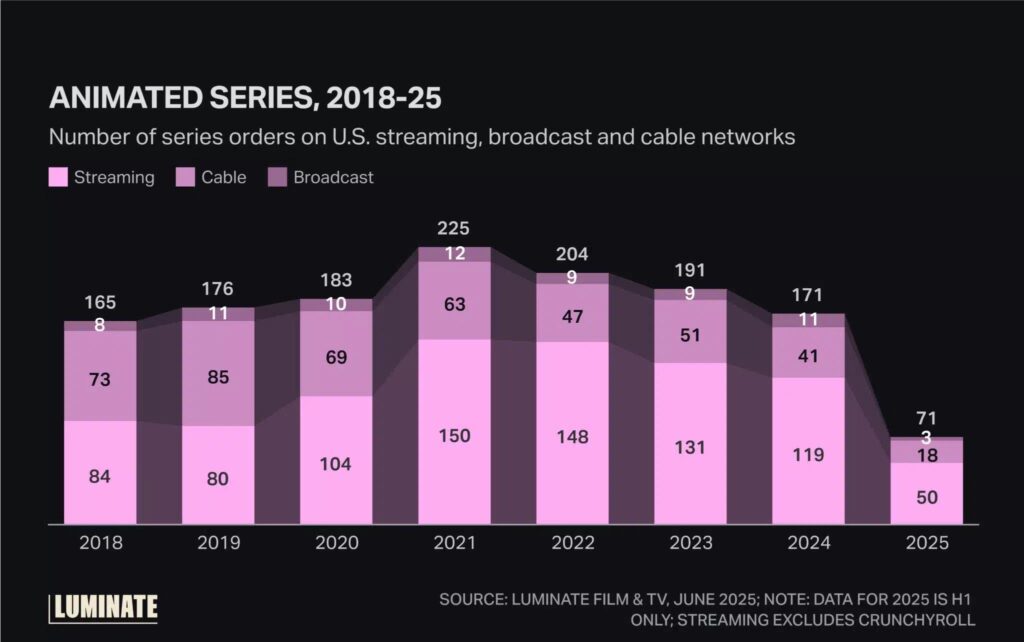
A reduced number of producers and fewer greenlit projects promises to create a precarious, even hostile job market. Volatility has plagued the U.S.animation industry since the adoption of "runaway" (overseas) production in the 1960s. The Animation Guild (TAG) fought for decades, with moderate success, to curtail this practice, but if the local job market continues to shrink, TAG will lose even leverage at the bargaining table. Furthermore, the combination of laid-off workers and approximately 7,000 students receiving degrees in digital arts and animation annually results in an oversaturated job market; the sector is currently projected to yield at best just 6,000 job openings per year.
Consolidation of the animation studios and streaming services proposed in this merger erodes an already weighted labor negotiation as animation workers compete for diminishing opportunities. In one example, when Cartoon Network requested that veteran animator C.H. Greenblatt pitch a revival of his hit series Chowder, both parties understood the pitch would be created for free. Afterward, the studio claimed it had no money for production and easily dismissed the labor already required in the pitch process. In a consolidated market, even proven industry talent like Greenblatt would be pressured to make concessions or work for free.


The transition from legacy channels to streaming also gives studios greater leverage by obscuring ratings data. Writer and showrunner Chad Quandt elaborates: “The streamers like to keep the numbers private… They may say you’re doing good... And then you go home and sit and think about whatever that could mean for three months.”
Loss of Talent and Diversity in the Workforce
Cuts would not be isolated to project development. They would also affect the development of a diverse workforce. Industry consolidation and corporate debt have already threatened popular talent development programs. The closure of the long-running Warner Bros. Television Writer’s and Director’s Workshops was announced in October 2022 as a cost-cutting measure after over 40 years as a pathway for marginalized talent, but backlash from alumni of the program as well as the Directors Guild of America (DGA) was able to reverse the decision. Potential Paramount-Warner Bros. CEO David Ellison has made no secret of his ire for diversity initiatives, and these programs would likely find themselves on the chopping block once again.
Animation talent would also struggle as their current and legacy series would be restricted by their ability to recoup corporate debt rather than by the quality of their work or even respective ratings. For example, Cartoon Network’s Infinity Train, though a critical darling, was not simply canceled, but erased from past Cartoon Network marketing and social media and pulled from streaming along with 36 other shows in the consolidation of HBOMax and Discovery+. The move understandably upset the shows’ creators, with creator Owen Dennis posting to social media that fans would have to resort to media piracy. Julia Pott, creator of the similarly canceled Summer Camp Island, took to X (fka Twitter) to voice their dissatisfaction:
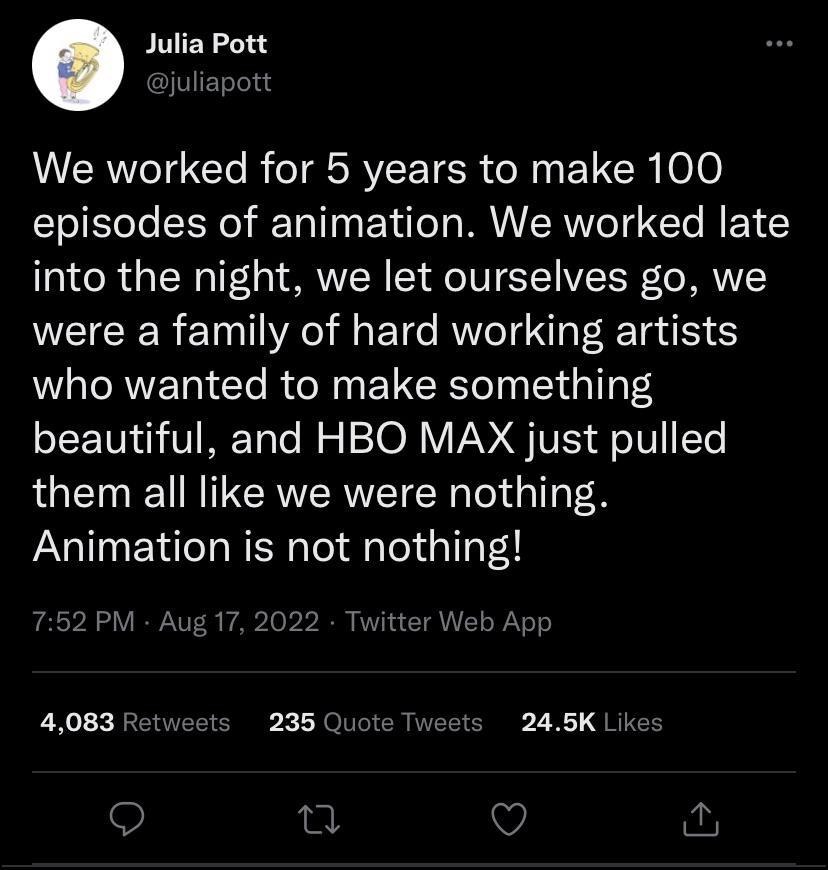
In addition to the perceived dismissal of their hard work, this also shuts the door on creators’ possible downstream benefits like residuals and royalties, or visible ratings reports which might generate interest at other distribution channels for syndication or series renewal. The long-running 20th Television Animation series Family Guy famously was saved from cancellation by DVD sales and syndication ratings, but Deadendia creator Hamish Steele, speaking to fans at FlameCon 2022, paints a grimmer picture today:
“What’s happening at HBO Max is so scary from a creator perspective? Like making a show for a streamer, you rarely get a chance for a physical release, or for it to air anywhere else, and being reminded they can just delete it from existence, all your work, your portfolio, awful!”
To be clear, these choices were made in response to Warner Bros.' then $50 billion debt after the 2022 Warner and Discovery merger. The eradication of these programs was part of a concerted corporate effort to find tax write-offs and avoid paying residuals. Animation workers remain understandably concerned about the $79 billion debt involved in Paramount Skydance’s proposed Warner Bros. Discovery acquisition.
Reduced Investment in Children’s Programming
Quality children's programming is already endangered due to the Trump administration’s defunding of public broadcasting in 2025. This merger, along with ongoing industry consolidation and profit-driven corporate logic, threatens to further restrict children’s access to quality programming. In 2015, HBO struck a questionable deal to air episodes of the beloved and acclaimed Sesame Street nine months before they were available on PBS. Then, in 2022, HBO further restricted access by removing nearly 200 episodes from its streaming service as part of a wider cost-cutting effort.
This is but one example of the trend toward disinvestment in children’s programming in order to offset corporate debt. In 2023, Warner Bros. merged long-time animation stalwart Cartoon Network Studios with Warner Bros Animation, closed the studio’s iconic Burbank office, and shifted production to Europe. In 2024, both Warner Bros. and Paramount shut down their youth-focused streaming apps, Boomerang and Noggin, respectively, and shut down Cartoon Network’s youth-focused webpage in post-merger consolidations. Even current children’s IP staples are not immune. At Paramount, the reboots Dora and Tales of the Teenage Mutant Ninja Turtles were cancelled in the consolidation of Nickelodeon, despite the latter’s canonical ties to the 2023 hit film, Teenage Mutant Ninja Turtles: Mutant Mayhem and its upcoming sequel.
J.B. Perrette, Warner Bros.’ head of streaming and video games, best summarized the post-merger corporate disregard for children’s programming: “That’s not a priority investment category for us.” In a consolidated industry motivated by post-merger debt constraints, children would lose access to quality programming.
Academic Experts
- Michael Gainey, PhD Candidate, Communication, UCSD
- Email: migainey@ucsd.edu
- Dawn Fratini, Lecturer in Animation, Loyola Marymount University
- Email: Dawn.Fratini@lmu.edu